Schedule of Sessions
Tuesday
9:30 – 11:00 (SCRS1)
Fix Your Shop’s Digital Marketing: A Live Advertising Workshop
Michaela Mundorf | Sokal, Director of Data, Advertising and Strategy
Austin Carroll | Sokal, Senior Project Manager
Lizzie Jones | Sokal, Senior SEO Specialist
Step inside the garage with automotive advertising professionals from Sokal in this interactive workshop designed specifically for collision repair businesses. This session will help shop owners and managers identify common weaknesses in their current advertising strategies and explore the digital tools that can help correct them.
Attendees will gain practical insight into how successful collision repair businesses approach digital marketing, including where shops commonly miss opportunities and how to build a stronger online presence that attracts the right customers.
The session will also include a dedicated open discussion where participants can bring their real-world marketing challenges to the room. Whether you are trying to improve an existing strategy or take your first steps into digital advertising, the panel will provide immediate feedback, ideas, and guidance tailored to your situation.
Marketing resources built specifically for the collision industry are rare. Drawing on experience developing digital strategies for collision centers and dealerships across the country, the Sokal team will share practical solutions and real examples that shop owners can begin applying immediately.
No waiting weeks for a consultation. No generic marketing advice. Just practical strategies, live feedback, and actionable ideas for collision repair businesses looking to improve their visibility and results online.
Why you should attend
9:30 – 11:00 (SCRS2)
Repair Planning That Pays: Protecting Revenue Through Research
Isaac Aronson | OEC, Product Manager, Repair Research Division
The industry talks about repair planning, but execution is inconsistent. This session focuses on how front-end research behaviors translate into measurable financial outcomes.
Modern vehicles require extensive OEM research, conditional procedure evaluation, and calibration consideration before repairs even begin. Yet inconsistent workflows create supplements, delays, and lost revenue opportunities for performed work.
Drawing on patterns across thousands of repair plans, this session identifies where breakdowns most commonly occur and how early research decisions influence final profitability. Rather than isolating ADAS, we demonstrate how embedding calibration evaluation into a structured workflow strengthens compliance and protects revenue.
Why you should attend
9:30 – 11:00 (SCRS3)
Reclaiming Technical Authority: The Collision Shop’s Fiduciary Role
Keith Manich | Automotive Training Institute, Vice President, Collision Division
Collision repair businesses operate within a framework that increasingly blurs the line between technical decision-making and deciphering payment accountability. As vehicle complexity rises and financial pressures intensify, repairers must reexamine their role and responsibility within the repair process.
This session explores how collision repair businesses can strengthen their position as the technical authority responsible for safe and proper repairs while navigating the realities of negotiation with insurers and other stakeholders. Attendees will examine the structural forces shaping the industry and how shops can adopt a more deliberate strategy that protects both their business and the consumer.
Rather than focusing solely on external pressures, this discussion challenges repairers to rethink how their operations are structured, how decisions are made inside the business, and what it means to act as a fiduciary for the vehicle owner.
Instead of asking, “What will insurers do next?” this session asks a different question:
What kind of operation must we become to remain relevant, defensible, and trusted in the modern repair environment?
Why you should attend
12:00 – 1:30 (SCRS4)
Beyond the Class: Turning Training into Real Shop Performance
Chris White | KECO Body Repair Products, CEO
Danny Hacker | KECO Body Repair Products, Training Director
+ Panel TBD
Training in collision repair is often treated as a single event, or a class that introduces a new concept, tool, or process. But regardless of how strong the curriculum may be, real change only happens after the class ends. Without intentional follow-through, most new ideas never make it into daily shop operations.
This session explores the difference between training events and training programs, and why the long-term success of training depends on building new habits inside the shop. Attendees will examine how successful businesses move beyond one-time classes and create a culture where learning, reinforcement, and implementation are built into everyday operations.
A cross-functional panel of technicians, shop owners and managers, and training providers will share their perspectives on what makes training effective, why many programs fail to produce lasting changes, and how shops can better support the development of their teams.
Why you should attend
12:00 – 1:30 (SCRS5)
The Estimator Bottleneck: How Modern Shops Shape Mindset for Complex Repairs
Deric Krist | Kri-Tech Solutions, CEO
Collision repair has evolved into a highly data-intensive, technology driven profession. Yet many shops continue to rely on manual workflows, duplicate data entry, and reactive processes that strain estimators and limit operational capacity,
Today’s estimators are expected to manage OEM procedure research, ADAS complexity, insurer negotiations, documentation requirements, and production coordination simultaneously. Without modern workflows and approaches, these responsibilities create an operational breaking point that slows repairs and increases friction across the entire business.
This session examines the mindset and process shifts required to modernize the front end of repair operations. Attendees will explore how structured workflows, automation, and data-driven communication can reduce estimator overload while improving accuracy, throughput, and negotiation outcomes.
Why you should attend
12:00 – 1:30 (SCRS6)
Capturing Mechanical Labor: Being Intentional About the Opportunity
Mike Anderson | Collision Advice, Owner
Mechanical operations are often an overlooked source of revenue and accuracy in collision repair. From pre-measurements and diagnostics, component removal and repairs, inspections, alignments and related procedures, many required mechanical operations simply never make it into the repair plan.
This session will explore industry data showing how frequently mechanical labor is under-identified or improperly classified in repair plans and why that gap exists.
Attendees will learn where these missed opportunities commonly occur, how to more thoroughly assess vehicles during blueprinting, and how to intentionally capture the mechanical operations required to perform safe, proper, and complete repairs.
Through practical examples and real-world repair scenarios, this session will help shop owners and managers better recognize mechanical work already being performed, ensure it is accurately documented, and understand how more intentional capture of mechanical operations can improve repair accuracy, labor allotment, and overall business performance.
This session sets the stage for the follow-up discussion on bringing mechanical repairs in-house and how shops can strategically build mechanical capabilities into their operations.
Why you should attend
2:30 – 4:00 (SCRS7)
Repair Transparency: The Key to Defensible Repairs and Better Outcomes
Arynne Kelly | DCR Systems, Store Support, Coach and Trainer
David Martin | DCR Systems, Director of Operations
Michael Giarrizzo Jr | DCR Systems, CEO
Barry Dorn | Dorn’s Body & Paint, Vice President
Kris Burton | Rosslyn Auto Body, Owner
As vehicles become more complex and repair requirements more technical, the gap between what is required to properly repair a vehicle and what is clearly communicated has never been wider. Greater transparency throughout the repair process is essential to protecting repair integrity, strengthening relationships with customers and insurers, and elevating professionalism across the industry.
This session explores why documentation, clarity, and accountability must become foundational elements of modern collision repair operations. Drawing from real operational experiences, the session will demonstrate how structured transparency can improve communication, support defensible repairs, and help align all parties involved in the repair process.
Rather than focusing on theory, attendees will be guided through a real-world claim from intake to final billing. The session will highlight where transparency commonly breaks down and demonstrates how those gaps can be addressed through clearer documentation and structured repair communication.
Using a live transparent claims package, participants will see firsthand how improved documentation can strengthen claim defensibility, improve insurer dialogue, and increase customer confidence.
Why you should attend
2:30 – 4:00 (SCRS8)
Run Your Collision Business Like a Fortune 100 Company
Rachel James | Torque Financial, Founder
The collision repair businesses that thrive long term do not just focus on repairing vehicles. They operate with the same strategic discipline, financial awareness, and leadership structure found in high-performing companies.
This session explores how Fortune 100 organizations approach strategy, financial planning, tax efficiency, leadership development, and adaptability; and how those same principles can be applied to collision repair businesses of any size.
Attendees will gain a practical framework for thinking and operating at a higher level, helping them build stronger financial performance, more resilient organizations, and businesses prepared for the future.
Why you should attend
2:30 – 4:00 (SCRS9)
Bringing Mechanical Repairs In-house
Steve Dawson | Hunter Engineering, Regional Manager
+ Panel TBD
More collision repair businesses are evaluating whether bringing mechanical work in-house can create new revenue opportunities, improve cycle time, and strengthen control over the repair process. But what does that transition really look like in practice?
In this panel discussion, leaders from high-performing shops share why they made the decision to expand into mechanical repairs, how they implemented the change, and what impact it has had on their operations and profitability. Expect a candid, real-world conversation about the challenges, investments, and lessons learned to help you determine whether bringing mechanical work in-house could make sense for your business.
Why you should attend
Wednesday
9:30 – 11:00 (SCRS10)
Stop Guessing, Start Earning: Building Bulletproof Repair Plans
Danny Gredinberg | Database Enhancement Gateway, Administrator
Andrew Batenhorst | Pacific Collision Center, Bodyshop Manager
Are you leaving earned labor hours on the table? Many repair plans rely too heavily on estimating software defaults, which can lead to missed operations, incomplete documentation, and lost revenue.
Join industry veterans Andrew Batenhorst and Danny Gredinberg for a high-energy, hands-on workshop designed to close the gap between a basic estimate and a complete repair plan. This session will focus on identifying, documenting, and capturing the critical operations required to perform safe, proper, and profitable repairs.
Rather than a traditional lecture, this interactive workshop will engage attendees in a collaborative exercise where participants work together to identify commonly overlooked operations and build a comprehensive repair plan in real time.
By working through real-world examples as a group, attendees will gain practical insight into where repair plans often fall short and how stronger repair planning can protect both repair integrity and shop profitability.
Participants will leave with a clearer understanding of how to move beyond default software assumptions and consistently build repair plans that accurately reflect the work required to repair today’s complex vehicles.
Why you should attend
9:30 – 11:00 (SCRS11)
The 3 Daily Mistakes Repair Shops Make That Empower Insurers
Sean Preston | Coverall Law, Managing Attorney
Tim Ronak | AkzoNobel, Senior Services Consultant
This session examines how routine shop practices can inadvertently give insurers leverage in negotiations and disputes. Rather than focusing on insurer behavior, the discussion shifts the lens inward, helping repairers recognize how small operational choices can influence payment outcomes, documentation strength, and overall negotiating position.
Built around three key categories – Protection, Payment, and Process – the presentation introduces 30 specific, actionable steps shops can implement to strengthen their position, reduce friction during claims handling, and improve operational clarity.
Instead of theory, this session focuses on practical adjustments supported by real-world scenarios. The format encourages audience participation and discussion, giving attendees the opportunity to explore how these concepts apply directly to the challenges they face in their own businesses.
Participants will leave with a set of practical changes they can begin implementing the very next business day.
Why you should attend
9:30 – 11:00 (SCRS12)
Own It: The Difference Between Responsibility and Accountability
Tony Adams | LeadersWay, Coach
Melissa Wolfe | LeadersWay, Coach
Many collision repair teams are full of “responsible” people, yet shops still struggle with missed deadlines, finger-pointing, comebacks and rework, broken processes, and constant frustration. Why? Because responsibility and accountability are not the same thing. This session breaks down the difference in a clear, simple, memorable way.
Rather than offering motivational talk about accountability, this session provides a practical leadership framework for creating a culture where people take ownership of results, not just assigned tasks. Leaders will learn how to set clearer expectations, reinforce follow-through without micromanaging, and address problems in a way that strengthens trust rather than damaging it.
The result is a leadership reset that improves performance, strengthens morale, and helps teams move forward with greater clarity and momentum.
Why you should attend
12:00 – 1:30 (SCRS13)
Speak Their Language: Communication That Actually Works in a Body Shop
Tony Adams | LeadersWay, Coach
Melissa Wolfe | LeadersWay, Coach
Collision repair environments are fast-paced, high-pressure, and full of strong personalities. With owners, estimators, technicians, painters, CSRs, and parts staff all working under tight timelines, communication breakdowns are common and often costly.
This session uses the DiSC communication model to help attendees quickly recognize how different people are wired, what information they need to hear, and how they prefer to be approached. Participants will learn practical ways to adapt their communication style to reduce conflict, speed up decisions, and improve collaboration across the shop.
Rather than focusing on theory, this session applies DiSC directly to real-world collision repair scenarios. Attendees will see how communication breakdowns affect cycle time, rework, morale, and profitability; and how small adjustments in communication style can produce immediate improvements.
The goal is simple: help leaders and team members communicate more effectively without changing who they are.
Why you should attend
12:00 – 1:30 (SCRS14)
The Profit & Control Playbook: Bringing Auto Glass In-House
Shauna Davis | Kaizen Glass Solutions, President
Jason Horne | Kaizen Glass Solutions, Auto Glass Education Director
Jorge Sandoval | Kaizen Glass Solutions, Spanish Auto Glass Education Director
Auto glass has become a critical component of modern collision repair, sitting at the intersection of ADAS calibration requirements, OEM repair procedures, and evolving insurance expectations. Yet many collision repair businesses still treat glass work as an outside service rather than a strategic opportunity.
This session explores how bringing auto glass operations in-house can strengthen repair quality, support OEM compliance, reduce sublet costs, and open new revenue opportunities for collision repair businesses.
Through real-world examples and operational insights, attendees will learn how successful shops have integrated glass services into their operations and how that shift has improved both repair control and financial performance.
Participants will gain a clearer understanding of what is changing in the repair environment, why glass operations are becoming increasingly important, and how shops can evaluate whether bringing glass in-house makes sense for their business.
The session will also highlight practical tools, resources, and implementation considerations to help shops make informed decisions about integrating auto glass capabilities into their operations.
Why you should attend
12:00 – 1:30 (SCRS15)
Financial Success Starts with a Plan: Turning Numbers into Action
Tracy Dombrowski | Collision Advice, Owner
Maria Quintero | Body Builders Automotive, Owner/Operator
Financial performance in collision repair does not improve by chance. It improves when business leaders clearly understand their numbers and use them to guide daily decisions.
This session is designed to help collision repair business operators gain clarity and control over their financial performance without getting lost in accounting jargon. Attendees will learn how to build and use a practical shop budget, calculate breakeven and desired net profit, and connect those financial targets directly to shop operations.
Participants will see how technician production, labor efficiency, and sales mix influence profitability, and how to set realistic technician production goals based on budgeted needs rather than guesswork.
The session will also explore how to quickly identify where to look when gross profit begins to drift off target so leaders can address small issues before they turn into major financial problems.
The focus is on practical decision-making, giving shop leaders the tools and confidence to use financial data to guide daily operational adjustments that protect margins and support long-term business stability.
Why you should attend
2:30 – 4:00 (SCRS16)
The IDEAS Collide Showcase
Join SEMA attendees for the IDEAS Collide Showcase; a one-of-a-kind event featuring multiple fast-paced, ten-minute presentations designed to stimulate thought, innovation, and resolution of business challenges inspired by perspectives from both in and out of the industry. Audience members will be intrigued by individuals and topics that seek to rattle the status quo with ambitious ideas that could have a transformative effect on the industry and your business.
Ryan Taylor | BodyShop Booster, CEO
The Body Shop That Works While You Don’t
For decades, collision shop owners have chased the same goal. A business that generates opportunities even when the shop is closed. Today, artificial intelligence is beginning to make that possible. In this session, Ryan introduces the AI-X3 framework. Artificial Intelligence, Automated Intelligence, and Actual Intelligence working together to help shops respond instantly to inquiries, nurture opportunities automatically, and stay engaged with customers around the clock. The result is a shop that operates continuously while allowing owners and teams to focus on higher value work.
Sean Preston | Coverall Law, Managing Attorney
The Law of Reasonable Pricing: Why Shops Must Be Paid and Customers Must Be Reimbursed
Many payment disputes in collision repair stem from a simple but critical misunderstanding. The shop’s right to be paid and the customer’s right to reimbursement are not the same legal obligation. Sean explains a perspective of how state and federal law define reasonable pricing, why reimbursement standards differ from shop compensation, and how that distinction shapes payment disputes. By connecting legal principles with real world repair scenarios, the discussion clarifies one of the most misunderstood issues affecting repair businesses today.
Joel Adcock | Revv, Director of Strategic Partnerships
The Scan is Not the Story: Closing the Gap Between Diagnostics and Calibration
A clean scan does not guarantee a safe repair. ADAS sensors can pass electronic checks while still being misaligned, and many OEM required calibrations will never trigger a diagnostic trouble code. Yet scan results are often treated as the final authority on calibration needs. This session explores the limits of diagnostic scans, why relying on them alone can lead to missed procedures, and how repairers can close the gap between diagnostics and OEM calibration requirements before a vehicle leaves the shop.
Brian Herron | OPUS IVS, CEO
Growing Your Business
Growing a business from a small team to a large organization requires more than ambition. It requires a willingness to challenge assumptions, take risks, and continuously adapt. Drawing from firsthand experience building companies from a handful of employees to hundreds, this session explores the lessons learned along the way. Through stories and practical insights, the discussion highlights the mindset shifts, leadership challenges, and strategic decisions that shape sustainable business growth in the automotive aftermarket.
Justin Allen | Hunter Engineering, Regional Trainer
What Will You Do When the Cars Stop Crashing?
Advances in ADAS and vehicle safety technology signal a future where there are simply less accidents, potentially forcing the industry to rethink its long-term role. The disruption of ADAS goes far beyond calibration and raises a larger question about how collision repair businesses will adapt as transportation technology evolves. This session challenges repairers to think ahead, identify emerging opportunities, and position their businesses to stay two steps ahead instead of constantly playing catch-up.
Daniel Burkholder | BodyShop Marketing, CEO
The AI Takeover: Is Your Shop Ready to Be Found?
Artificial intelligence is rapidly reshaping how customers search for and choose collision repair businesses. AI driven search tools are shifting the focus from traditional rankings toward trust, authority, and clear answers to customer questions. We are going to explore how AI evaluates businesses, why Answer Engine Optimization is emerging alongside traditional SEO, and what collision repairers need to understand to remain visible as search technology continues to evolve.
Maria Quintero | Body Builders Automotive, Owner/Operator
Technician Roadmap: Financial Awareness Leads to Technician Excellence
Technicians perform better when they understand how their work connects to the financial health of the shop. This session outlines the concept of career roadmap that links skill development, efficiency, and accountability to both shop profitability and technician growth. By helping technicians see the value they create and how their performance contributes to the success of the business, leaders can build stronger engagement, clearer goals, and a path toward long-term professional development.
Thursday
12:30 – 1:30 (SCRS17)
The National Safety Objective: Safer Vehicles, Safer Roads
Featuring Lee White, Deputy Administrator, National Highway Traffic Safety Administration (NHTSA)
Updated Session details:
Vehicle technology is advancing at an extraordinary pace, creating new opportunities to prevent crashes, mitigate their severity and protect vehicle occupants and other roadway users. At the center of the nation’s efforts to advance those outcomes is the National Highway Traffic Safety Administration.
NHTSA Deputy Administrator Lee White will open the 2026 OEM Collision Repair Technology Summit with a presentation on the agency’s current vehicle and roadway safety priorities, emerging transportation technologies, data-driven research and the federal government’s work with industry to reduce fatalities and serious injuries.
White provides executive leadership for the federal agency responsible for establishing and enforcing vehicle safety standards and educating Americans about roadway safety. His work includes development and execution of the federal regulatory framework for automated vehicles, leveraging research and data to guide safety initiatives, and positioning the agency to address emerging vehicle technologies.
Prior to joining NHTSA, White served as the U.S. Department of Transportation’s Deputy Assistant Secretary for Research and Technology and has held leadership roles developing strategies, business models and operational roadmaps for automated vehicles.
Following his presentation, White will join SCRS Executive Director Aaron Schulenburg for a one-on-one conversation exploring the intersection between federal safety objectives, automotive innovation and the collision repair industry’s role in preserving vehicle safety throughout its service life.
The conversation will explore:
NHTSA safety priorities • automated and advanced vehicle technologies • data and research • emerging safety risks • industry collaboration • the role of repair in maintaining vehicle safety.
2:00 – 3:00 (SCRS18)
OEM Summit – Session II
The OEM Collision Repair Technology Summit is designed to put collision repair businesses in a room with innovators in automotive structural design and technology. The event features three unique sessions, each will highlight ways in which the development of modern vehicles has influenced vehicle repairability.
Individual topics for each session are unveiled Map Your Show, and past events have delved into topics such as alternative fuels, safety technologies, vehicle design, construction and material makeup. Find past sessions online at https://rde.scrs.com.
Each session will focus on emerging trends and collision industry preparation so that the industry can benefit from better insight into how vehicles, materials and technologies are evolving, and what that means in the repair process.
3:30 – 4:00 (SCRS19)
OEM Summit – Session III
The OEM Collision Repair Technology Summit is designed to put collision repair businesses in a room with innovators in automotive structural design and technology. The event features three unique sessions, each will highlight ways in which the development of modern vehicles has influenced vehicle repairability.
Individual topics for each session are unveiled Map Your Show, and past events have delved into topics such as alternative fuels, safety technologies, vehicle design, construction and material makeup. Find past sessions online at https://rde.scrs.com.
Each session will focus on emerging trends and collision industry preparation so that the industry can benefit from better insight into how vehicles, materials and technologies are evolving, and what that means in the repair process.
9:00 – 11:59 (SCSRSKY)
SCRS Sky Villa Afterparty
The premiere collision industry networking event during SEMA Week, in one of the most special and historic suites on the Las Vegas strip! Aside from education, networking is one of the key benefits attendees gain from attending events such as the SEMA Show. This famed evening event provides unique experiences in some of the most sought-after suites in Las Vegas. The afterparty has become a fixture of the Show for high-profile individuals within the collision repair communities from across the globe, providing guests with a well-earned opportunity to let their hair down and enjoy and evening amongst friends after a week of exploration and education.
Tickets are limited, and early registration is encouraged.
SPONSORS
Masters Level


Bachelor Level



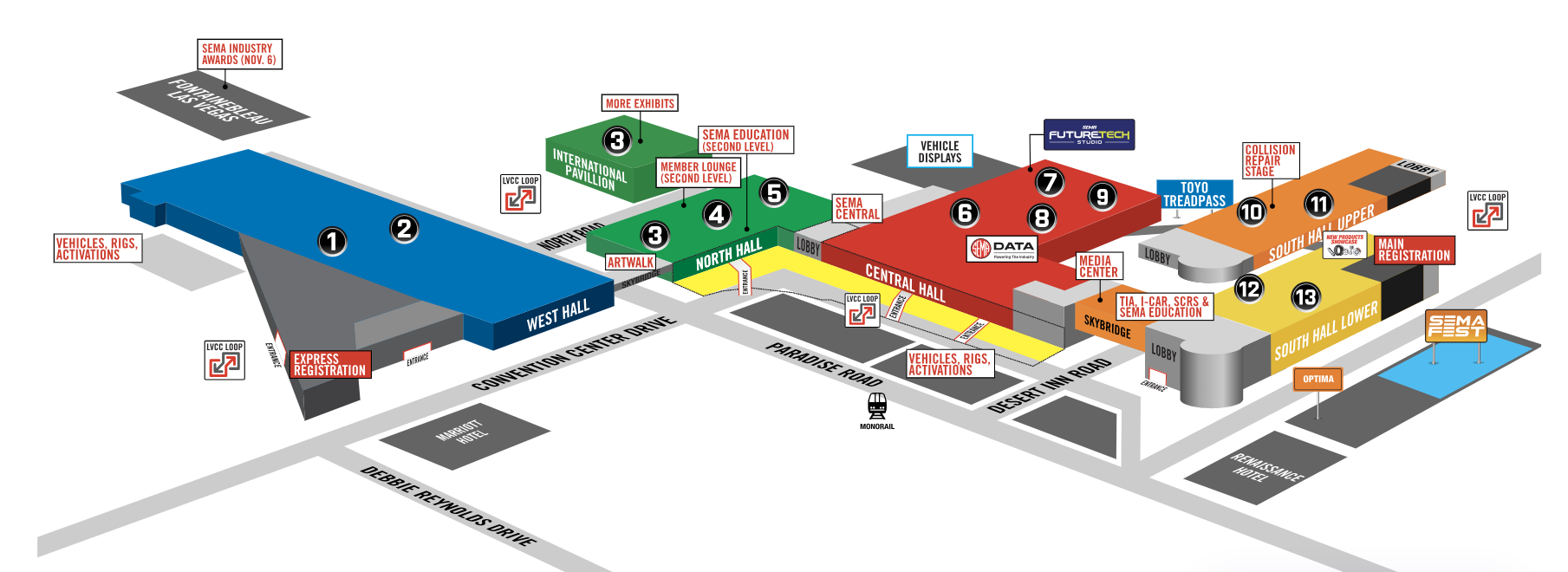
Explore Upper South Hall
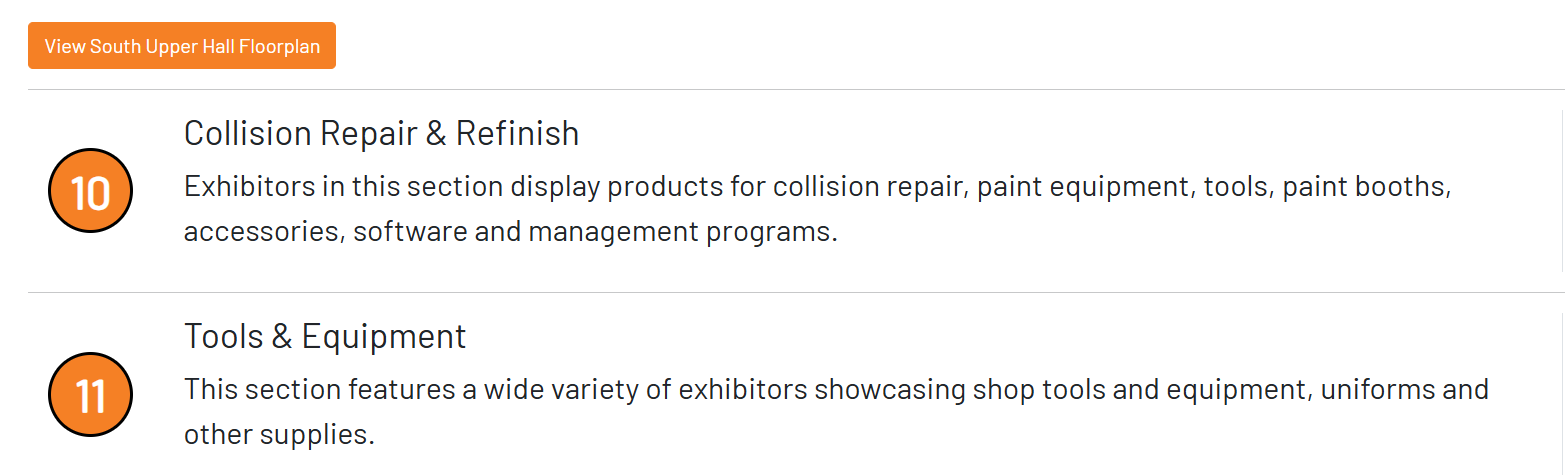
Featuring Collision Repair & Refinish and Tools & Equipment: